Publishing careers / Editorial
Editorial Careers in Book Publishing: What Editors Actually Do
Somebody spots the promise in a manuscript that isn't finished. Somebody else asks why chapter six starts with a scene that belongs in chapter two. There are rights to confirm, schedules to keep alive, revisions that arrive a fortnight late and a cover meeting at which everyone has a different opinion. Editorial work sits inside that tangle. It is creative, yes, but the romantic image of a book editor spending all day reading beautiful novels is missing most of the job.

A Book Doesn't Reach the Shelf on Good Writing Alone
If you are thinking about an editorial career, a better starting question is what kind of responsibility you want. Do you like finding books? Working closely with authors? Improving sentences? Or keeping a complicated project moving when six people are waiting on one file? Publishers divide those tasks differently, and job titles can be annoyingly inconsistent.
Editorial Assistant: Learning the Machinery
An editorial assistant may handle submissions, meeting notes, schedules, author correspondence, permissions queries, metadata or internal paperwork. They might also read manuscripts and prepare short reports. The proportion depends on the company and the imprint. An assistant at a small independent press can touch almost every stage of a book; someone at a large house may work within a more defined list or department.
The administrative work isn't an unfortunate detour from the “real” job. It is how you learn where decisions are made and what happens when information fails to reach the right colleague. A missing deadline or incorrect title in a system can create more trouble than a weak adjective.
Good assistants write useful emails. They catch errors without making a scene. They understand that a polite follow-up is sometimes the only thing keeping a manuscript on its path.
Acquisitions, Commissioning and Developmental Editing
An acquisitions or commissioning editor helps determine which books a publisher should pursue. That means reading proposals, discussing market position, considering a list's existing titles and working with colleagues in sales, marketing, finance and rights. The editor may admire a manuscript and still decide it does not fit the company's programme. Publishing is a creative trade with a balance sheet attached.
A developmental editor works with the larger shape of a book: organisation, argument, pacing, character, audience, missing evidence. In nonfiction, a manuscript may need structural work long before anyone checks punctuation. With fiction, the difficult conversation could be about a narrator who never quite comes alive. The work requires judgment and tact, not simply a sharpened red pen.
Publishing houses vary in where these responsibilities sit. Freelance developmental editors also work directly with authors, but that is not the same commercial relationship as acquiring a book for a publisher.
Copy Editing, Proofreading and Production Editorial
Copy editing attends to consistency, clarity, grammar, house style and the small contradictions that pile up across a long text. Proofreading happens at a later stage, checking page proofs or other near-final output for errors and production issues. Neither is merely “reading carefully”. Each has a different place in the workflow, and the boundary can blur when budgets are tight.
Production editors coordinate the route from edited manuscript to finished formats, often working with freelancers, designers, typesetters and printers or digital production colleagues. They may manage proofs, version control and corrections. If you enjoy systems as much as sentences, production editorial deserves a serious look.
| Editorial role | Main focus | Evidence you could show an employer |
|---|---|---|
| Editorial assistant | Workflow, correspondence, reports and coordination | Clear reader report, organised project tracker, concise emails |
| Acquisitions / commissioning | Finding and selecting publishable projects | Audience analysis, a persuasive acquisition memo |
| Developmental editor | Shape, argument, narrative and structure | Thoughtful structural edit with reasoning |
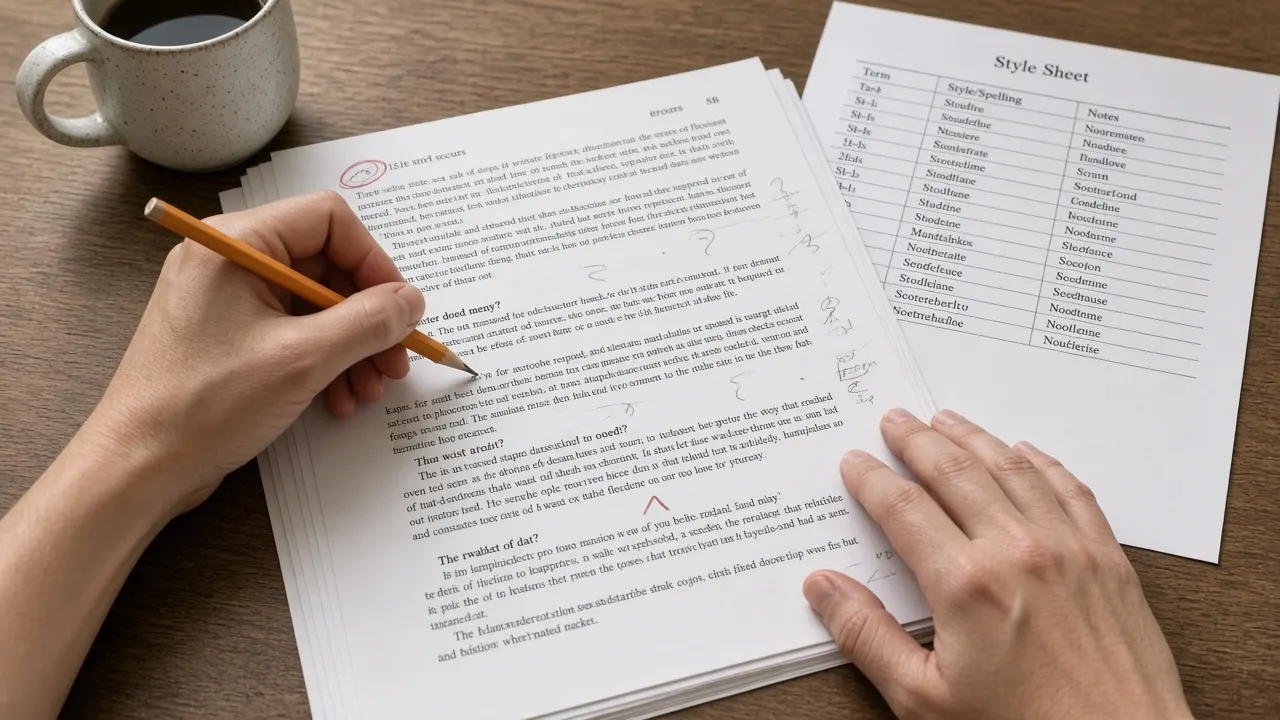
| Copy editor | Accuracy, style and consistency | Marked sample with style sheet |
| Production editor | Proofs, schedules, files and delivery | Mock production schedule, quality checklist |
These labels describe common functions, not a universal hierarchy used by every publisher.
What Hiring Managers Can Actually Evaluate
“I love books” is an understandable reason to apply. It isn't evidence of the skills you'll use. A stronger application shows how you read, write, organise and make decisions. For example, choose a published book and prepare a concise reader's report: intended readership, strengths, concerns, and a suggestion about how it could be positioned. You are not pretending to have commissioned it. You are demonstrating editorial judgment.
You could also compare two editions for consistency, build a style sheet from a sample chapter, write a professional revision note or explain how a publication calendar works. These are small projects, but they give an interviewer something real to discuss. And they can be created without unpaid labour for an employer.
Prior work from libraries, journalism, community organisations, academic journals, retail, customer support or project administration may be relevant. The common thread is not prestige. It is proof that you can work accurately with other people and written material.
Pay, Competition and the Slow Path Up
The U.S. Bureau of Labor Statistics reported a $77,920 median annual wage for editors across all industries in May 2025, with employment projected to change by −1% from 2025 to 2035. Those are broad occupation-wide figures. They do not describe the salary of a new editorial assistant at a book publisher, nor do they establish what any named imprint will pay. Starting salaries can be substantially different. See our Publishing Salaries guide for the scope of each dataset.
The outlook is not a command to abandon editorial work. Even an occupation with flat or falling total employment can have openings when people change jobs or retire. It does suggest that applicants should cultivate transferable skills, compare employers carefully and resist the idea that one famous imprint is the only place to build a career.
How an Editorial Career Changes Over Time
An assistant may progress into an editor role, specialise in a genre, move toward managing a list or switch to rights, production, content operations or freelance editing. There is no universal ladder. Some people love manuscript development and never want to manage a department. Others discover that negotiating schedules and setting priorities is where they are strongest.
Keep learning about how books are sold, not just written. Talk to sales colleagues. Understand why metadata matters. Follow how print, ebook and audio versions of the same title move through different workflows. A good editor is often the person who can see the entire book, including the parts outside the manuscript.
For a wider map of departments, start with Career Paths. For skills that sit beside editorial work, see Jobs & Career Outlook.
FAQ
Is a degree in English required to work in book editorial?
No single degree guarantees entry. English, communications and related subjects are common backgrounds, but demonstrable reading, writing and organisational skills matter, and specialist lists may value subject knowledge.
Do editorial assistants spend the whole day reading manuscripts?
No. Correspondence, records, schedules, meeting preparation and coordination can make up a large share of the role. The balance depends on the team.
Is proofreading the same as copy editing?
No. Copy editing usually works on language and consistency before final layout, whereas proofreading checks near-final proofs for remaining errors. Employers sometimes blur the labels.
Can I build an editorial portfolio without publishing experience?
Yes. A clear sample reader report, style sheet, annotated edit or production schedule can show your thinking. Label speculative examples honestly.
Are editorial salaries uniform across the book trade?
No. Role, geography, seniority, employer size and employment type all affect pay. Broad U.S. occupational medians must not be mistaken for entry-level book-industry offers.